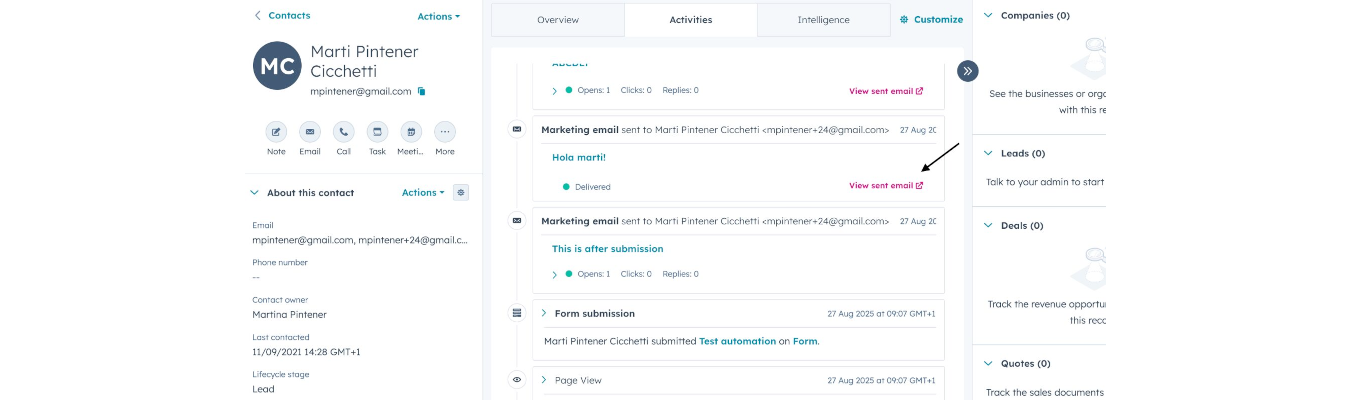
Using a lot of smart content, programmable email modules, or dynamic AI text tokens in your marketing emails?
Then you probably know how difficult those emails can become to debug once personalization layers start stacking on top of each other.
From a marketing operations perspective, one recurring challenge has always been visibility.
What exactly did this contact receive?
Not the generic template. Not the draft version visible in the email editor. The actual rendered email, with all personalization, smart rules, AI-generated text, and dynamic content applied.
HubSpot recently introduced a new feature that addresses this gap directly.
New Feature
You can now view the exact version of a marketing email a specific contact received directly from the contact record timeline.
This applies to emails using:
- Smart content
- Programmable email modules
- Dynamic AI-generated text
Why This Matters for Marketing and Sales Teams
As personalization becomes more advanced, troubleshooting and alignment between teams becomes harder.
A sales rep preparing a follow-up often has no clear visibility into:
- which version of the message was shown,
- which product recommendation appeared,
- or whether personalization rendered correctly.
Marketing teams face a similar issue when debugging campaigns. Until now, understanding what a contact actually received often required recreating conditions manually or checking multiple assets across workflows and email modules.
This new feature simplifies that process considerably.
What Changes Operationally
The biggest value is not the feature itself, but the reduction of friction around personalized communication.
In practice, teams can now:
- Verify how smart content rendered for a specific contact
- Troubleshoot personalization issues faster
- Reduce back-and-forth between sales and marketing
- Give sales teams better context before outreach
- Confirm whether AI-generated sections displayed as expected
For organizations running advanced segmentation and dynamic email experiences, this creates much better transparency.
A Few Important Limitations
There are a couple of important details worth knowing before relying on the feature operationally.
First, this is designed for advanced personalization scenarios. Standard emails using simple tokens such as first name or company name are not the primary use case.
Second, the rendered email version is currently available for 30 days after sending.
So while this is very useful for recent campaign analysis, it is not intended to become a permanent archive of personalized email renders.
Availability
This feature is currently in public beta and available across all HubSpot plans.
For teams heavily using personalization, smart content, or AI-driven messaging, this is a small update that can remove a surprising amount of daily friction.